


The truth is, you don’t need solar or a battery to power an EV charger. EV chargers can be powered from the grid just like any other appliance in your home. The key advantage of coupling solar and batteries with an EV charger is the savings in electricity - a correctly installed system can save you thousands in the long run.
Simply put, EV chargers deliver more power, which means your car fills up much quicker. A standard powerpoint trickles around 1.8kW - a dedicated wall charger delivers 7kW or more, so you’re looking at 4x the charging speed.
They’re also neater and more convenient, giving you a dedicated charging point. On top of that, you unlock added benefits like load management charging and time-of-use charging, which we’ll cover below.
We all know solar generates electricity when the sun is shining - but what happens to the power you don’t use? Whatever isn’t used in your home goes back to the grid for a very small feed-in tariff.
A correctly installed EV charger can change this. It monitors what your home is using as well as what your solar is making, and sends the excess solar to your electric vehicle. Instead of paying 30c per kWh, you’re now charging your car for free.
This is where it gets tricky, and it comes down to how many kilometres you plan to do each day. There are two effective ways to charge your EV at night:
• From a home battery.
• On an energy plan that offers a cheap EV charging rate - typically 4–8c per kWh overnight.
If you only need to top up 10km per day, it’s fair to do that from a battery. If we’re talking 30km per day or more, it’s often worth charging from the grid on a dedicated EV plan instead. Home batteries are great for taking care of peak electricity usage when grid power hits 50c+, but we don’t want to spend more than we need to on an oversized battery if we can charge cheaply from the grid overnight instead.
If you have a fairly consistent driving schedule, there are ways to make it work. Let’s say you drive to work 5 days a week and average 50km per day - that’s 250km over the working week.
If the car is at home during the day on weekends, you can do one big solar charge then. And if needed, your battery can do small top-ups during the week. The result: most of your driving comes from free solar power.
Absolutely - and it’s a great option for many homeowners. The Solar Sharer program starting July 1st is offered by energy retailers and gives you access to free power from the grid between 11am and 2pm, when the network is flooded with cheap daytime solar. The only catch is the daily cap of 24kWh.
Using it for EV charging is simple. Plug your car in, schedule the charge through either your car or your charger to run inside that window, and walk away.
Great question - and the good news is, you can use your normal single phase power. However, there are limitations around how fast you can charge.
The largest single phase EV chargers come in at 7kW, while three phase chargers go up to 22kW. To put that into perspective: a 7kW single phase charger gives you around 30–40km of range per hour, while a 22kW three phase charger delivers around 100–110km per hour.
It depends on how many kilometres you drive between charges. Let’s look at how much a typical 6.6kW solar system generates in NSW versus how much a Tesla Model S uses across three different driving ranges - 20km, 50km and 100km per day.
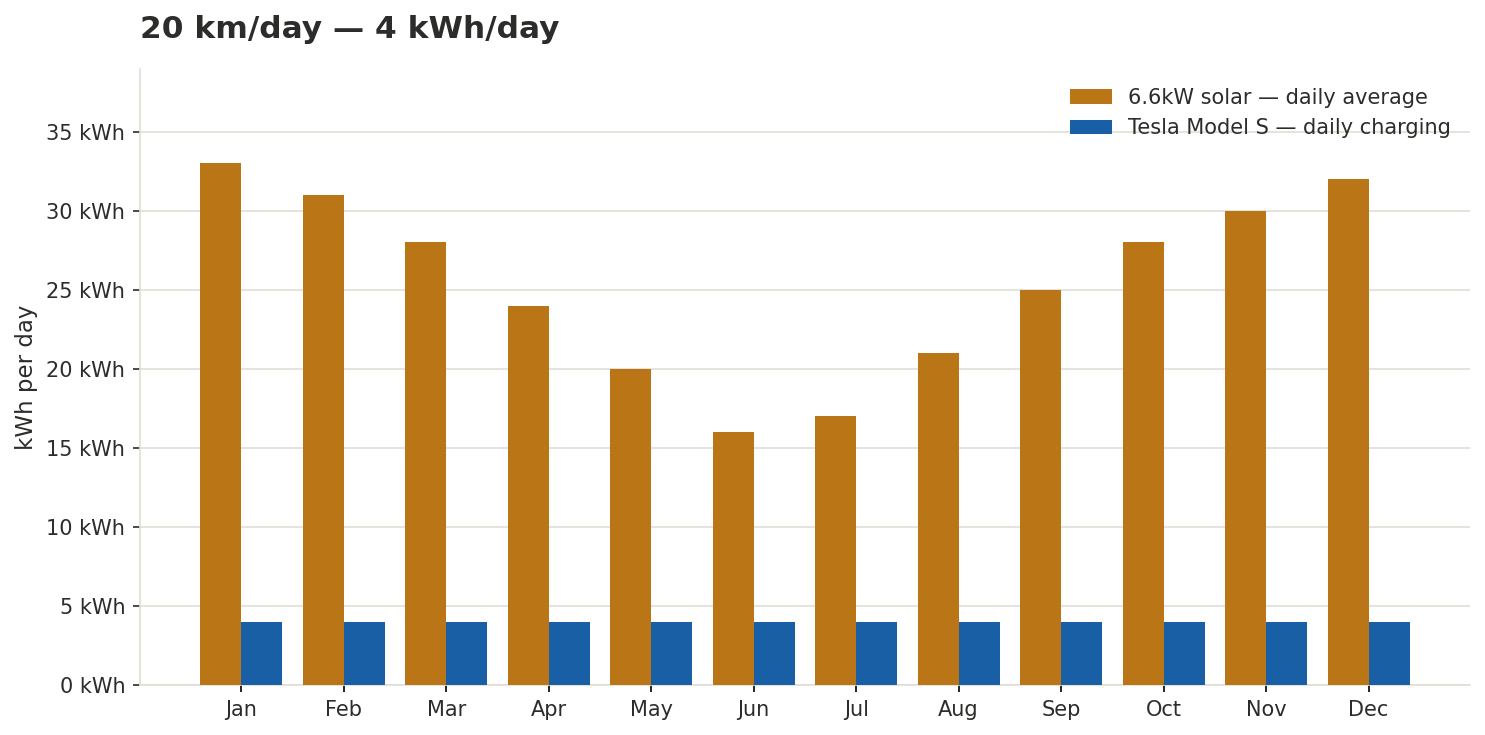
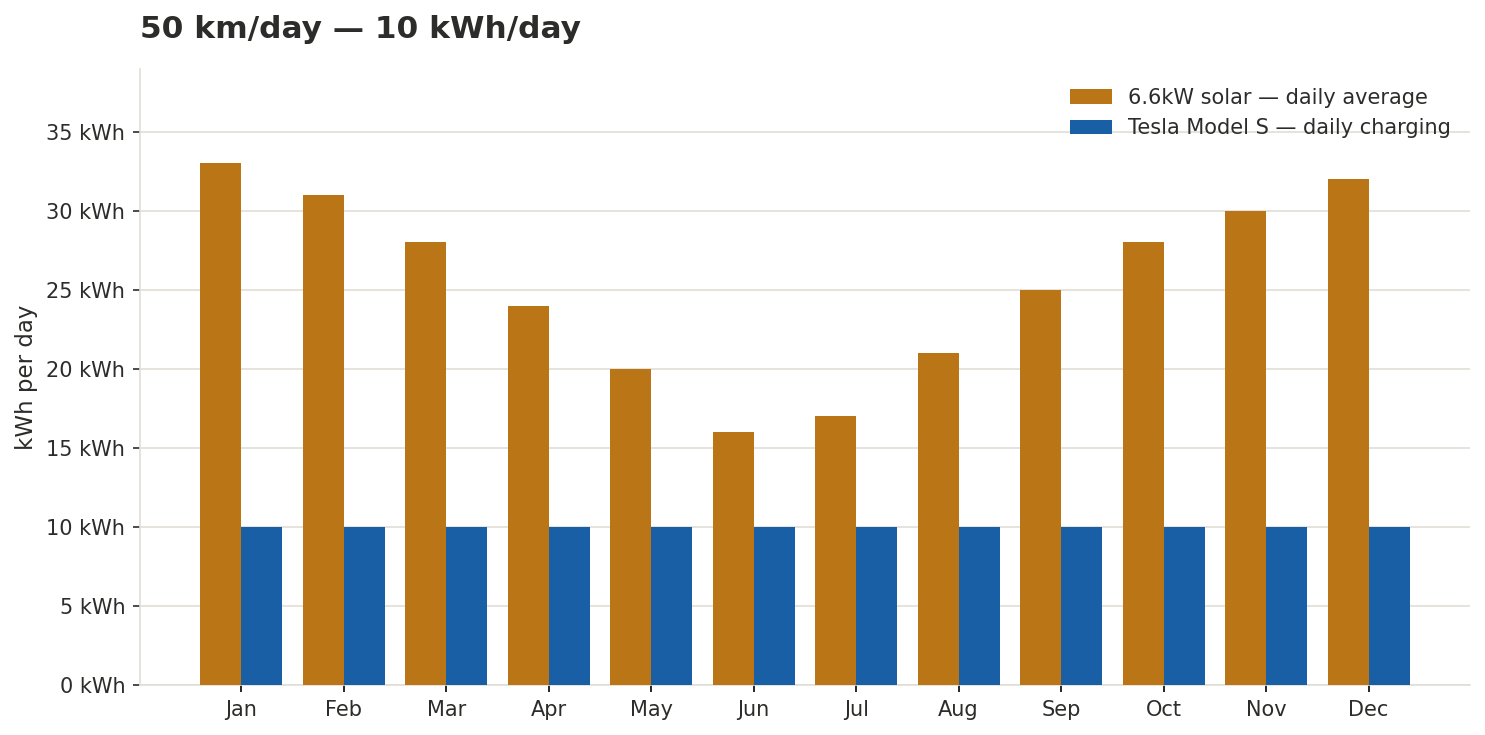
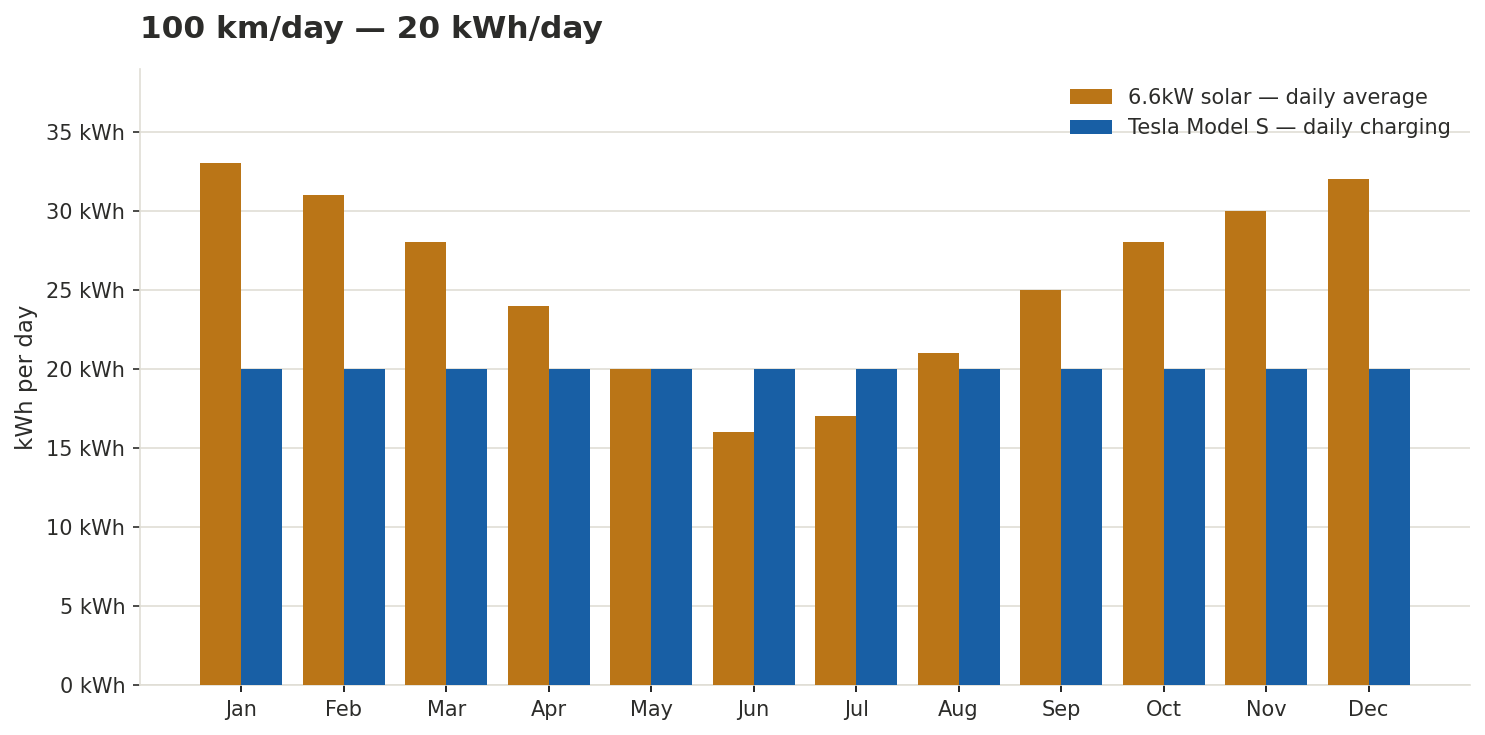
The orange bars represent the average daily solar generation for a 6.6kW system in NSW, with panels facing north. It’s important to note that other usage factors come into play - if you’re powering a battery, pool, hot water system, air conditioning and more, you may need a larger solar system to comfortably cover everything.
The blue bars represent the Tesla’s daily charging need based on how many kilometres you’ve driven. For every 100km in a Tesla Model S, expect to use around 20kWh. Different cars use different amounts - some more, some less - but this gives a reliable benchmark.
Vehicle-to-Grid (V2G) and Vehicle-to-Home (V2H) flip the script. Instead of the grid charging your car, the car sends power back to your home or out to the grid through a compatible EV charger.
It’s worth noting that V2G and V2H aren’t widely supported just yet, as the tech is still emerging in Australia. But the line-up is growing fast.
EV chargers that currently support it:
1. Sigenergy SigenStor
2. Numbat
3. RedEarth Boomerang
4. Wallbox Quasar 2
EVs that currently support it (or have compatibility coming):
1. Nissan Leaf
2. Mitsubishi Outlander PHEV / Eclipse Cross PHEV
3. Kia EV9
As you can see, choices are limited at the moment. The Sigenergy SigenStor 5-in-1 system is by far the most complete package on the market for homeowners who want a full ecosystem in one box.
The 5-in-1 refers to:
1. Solar inverter - converts DC power from your solar panels into AC power your home can use.
2. Hybrid inverter - manages power flow between solar, battery, grid and home simultaneously.
3. Battery storage - stores excess solar energy for use at night or during outages.
4. EV charger - built-in 25kW DC charger to charge your EV directly from the unit.
5. Backup power / blackout protection - seamless switchover during a grid outage, including full 3-phase backup.
This is another great question, and it all comes down to your setup. Let’s run through a few real-world scenarios.
I already have solar/battery and I want to add an EV charger
Check whether the brand of your existing system makes an EV charger. Sticking with the same brand streamlines everything into one app and reduces the number of components you need.
Examples of systems with their own chargers:
1. Sigenergy SigenStor
2. GoodWe HCA
3. SolarEdge Home Hub
4. Fronius + Wattpilot
5. Enphase
More brands are releasing compatible chargers all the time. If you’re unsure, send us a message about your system and we’ll let you know what fits.
I already have solar but I can’t find a compatible charger
In this case, you’ll want what’s called a smart charger - specifically one with dynamic load management. It monitors how much your solar is making, how much your house is using, and sends any excess solar straight to your car.
Examples of smart chargers:
1. Zappi
2. Ocular IQ Home Solar
3. Evnex E2 Plus
4. Ohme Home Pro
I don’t have solar - I just want an EV charger that works when I plug it in
In this case, you’re after a dumb charger. They’re not actually dumb - they just don’t have as many protocols compared to smart chargers. They’re generally cheaper and get the job done.
Most also work with time-based control, so if you’re on an EV plan or have a cheap overnight rate, you can program the charger to switch on during those hours.
Examples of dumb chargers:
1. Tesla Wall Connector
2. JET Charge JET-1
3. Schneider Electric EVlink
There are plenty of other options, and most vehicle manufacturers offer their own dumb charger too.
Going solar and EV doesn’t have to be confusing - it just needs to be set up smart to save you money. Whether you’ve got a solid plan or you’re still working it out, contact Steel City Solar and Electrical and we’ll help bring it to reality.
We look at your setup, do an on-site assessment if needed, and provide you with a free quote. No obligations - just a friendly quote from a locally based company.


See your federal Cheaper Home Batteries rebate in seconds.
These are estimates. A proper quote accounts for your roof, existing system, usage pattern, and the exact battery model.
Get a free battery quote →Estimates only. Calculated at 6.8 STCs/kWh (tier 1), 4.08 STCs/kWh (tier 2), 1.02 STCs/kWh (tier 3). Confirm current STC rate with your installer. Last updated August 2026.