

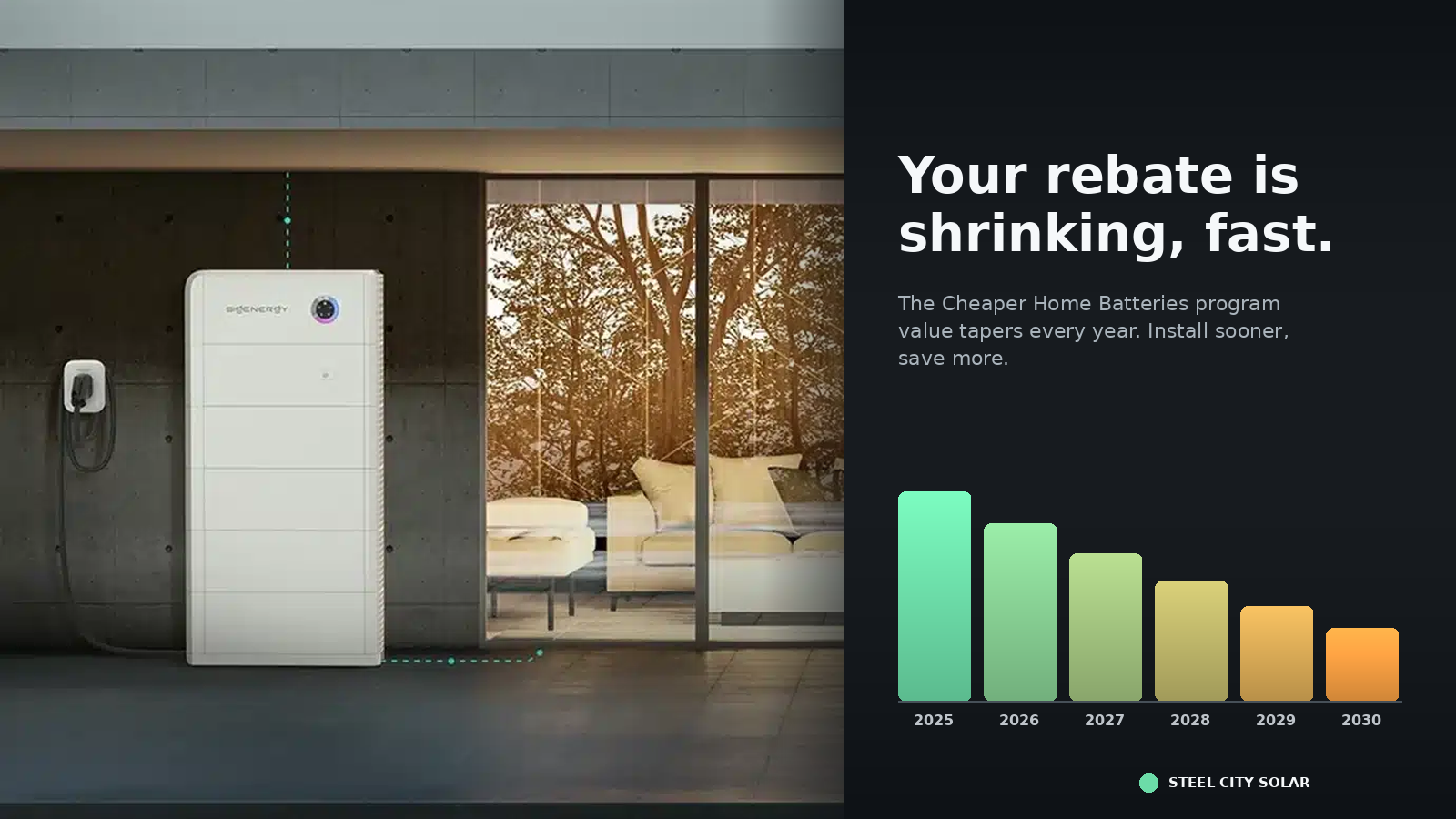
Yes, the federal Cheaper Home Batteries rebate is still available in 2026, but the way it's calculated has changed. The rebate still takes a substantial chunk off the cost of a system; it's just been restructured to favour right-sized installations and discourage people from oversizing. In practice, that means smaller systems are less affected - only large ones see a meaningful reduction.
If you've been thinking about adding a battery to your solar system, or installing solar and battery storage from scratch, it's worth understanding exactly where the rebate sits today, what's changed, and how much you can actually save.
Launched on 1 July 2025, the Cheaper Home Batteries Program is a federal rebate that reduces the upfront cost of an eligible home battery by roughly 30%. It works through the same Small-scale Technology Certificate (STC) system that has subsidised rooftop solar in Australia for years - meaning the discount is applied at the point of sale by your installer, not claimed back later.
In December 2025, the government expanded the program's funding from $2.3 billion to around $7.2 billion, signalling that the scheme is here to stay for the medium term.
Two things worth knowing.
1. The rebate now drops every six months. Since 1 May 2026, the STC value of the rebate has stepped down every six months, rather than annually like the original solar STC scheme. A battery installed this deeming period attracts a bigger rebate than one installed in the next.
2. Bigger batteries get a smaller rebate per kWh. Also from 1 May 2026, the rebate is tiered by battery size. The first 14 kWh of usable capacity still gets the full STC factor; capacity between 14 and 28 kWh gets 60%; capacity between 28 and 50 kWh gets 15%. Anything above 50 kWh isn't rebated. The goal is to keep the discount at roughly 30% for sensibly-sized systems while reining in the windfall on very large installations.
Before 1 May 2026, the rebate was worth approximately $311 per kWh of battery installed.
As of May 2026, it's approximately $252 per usable kWh of battery capacity, for the first 14 kWh. Once you go above that, the rate tapers.
The exact $/STC moves with the market, so $250–$255/kWh is a reliable ballpark.
The rebate is tiered based on battery size:
• Up to 14 kWh usable: full rebate (~$252/kWh)
• 14–28 kWh usable: 60% of the full rebate (~$151/kWh)
• 28–50 kWh usable: 15% of the full rebate (~$38/kWh)
• Above 50 kWh usable: no rebate
If you're in NSW, you can stack this federal rebate with the state Peak Demand Reduction Scheme (PDRS) Virtual Power Plant incentive - adding roughly $720–$1,500 net on top of the federal discount. Steel City Solar handles the paperwork for both, so you don't need to chase it yourself.
Here's what the rebate looks like across common battery sizes at the current May 2026 rate. (These figures will be updated when the next step-down takes effect.)
5 kWh - 34 STCs: approx. $1,260
10 kWh - 68 STCs: approx. $2,520
13.5 kWh - 91.8 STCs: approx. $3,400
16 kWh - 103 STCs: approx. $3,820
20 kWh - 119 STCs: approx. $4,400
27 kWh - 148 STCs: approx. $5,470
40 kWh - 165 STCs: approx. $6,090
Calculated at 6.8 STCs/kWh up to 14 kWh, 4.08 STCs/kWh (60%) from 14–28 kWh, and 1.02 STCs/kWh (15%) from 28-50 kWh, with each STC valued at ~$37.
To qualify, your battery system needs to tick the following boxes:
• Nominal capacity between 5 kWh and 100 kWh (with rebate-eligible usable capacity capped at 50 kWh)
• On the Clean Energy Council (CEC) approved product list
• Installed by an installer accredited through Solar Accreditation Australia (SAA)
• VPP-capable (so you can opt in later if you choose to)
• Paired with a solar PV system (existing or new)
You can claim the rebate once per property, so getting the right-sized system installed the first time around is critical.
You don't have to fill out any forms. Your accredited installer handles the STC paperwork and applies the discount directly to your quote. When you compare quotes, make sure each one clearly shows the rebate as a line item so you can see what you're really paying.
Because the rebate steps down every six months, waiting means a smaller discount - not a bigger one. The other factor is your power bill: every quarter without a battery is another quarter buying energy from the grid at peak rates.
In most cases, yes. Older inverters may need to be paired with a separate battery inverter (an "AC-coupled" setup), while newer hybrid inverters can connect a battery directly. A site assessment will confirm what's compatible.
Only if it's wired with backup loads. Not every battery includes blackout protection by default, so let your installer know if it's important to you.
No, the battery just needs to be VPP-capable. Whether you opt into a virtual power plant later is up to you.
For most NSW households on a typical retail tariff, a properly sized battery pays itself back in 6–9 years and continues delivering savings well beyond that. The exact figure depends on your usage pattern, solar system size, and electricity plan.
Every home is different, so the best way to know exactly what a battery will cost you, and save you, is to get a tailored quote based on your roof, your existing system, and how you use power.
We'll walk you through the rebate, the right battery size for your home, and what your actual payback looks like. No pressure - just a friendly, informative chat about how we can help you reach your energy goals.


See your federal Cheaper Home Batteries rebate in seconds.
These are estimates. A proper quote accounts for your roof, existing system, usage pattern, and the exact battery model.
Get a free battery quote →Estimates only. Calculated at 6.8 STCs/kWh (tier 1), 4.08 STCs/kWh (tier 2), 1.02 STCs/kWh (tier 3). Confirm current STC rate with your installer. Last updated August 2026.