Including a calculator to determine exactly how much the rebate is worth for every size battery.
What is the Cheaper Home Battery Rebate?
On July 1st 2025, the Australian Federal Government launched a program called the ‘Cheaper Home Batteries Scheme’. The program was launched to help homeowners get into the battery market, by taking around 30% of the upfront cost off the system.
What’s Changed?
The program started off with a budget of $2.3 billion. However, no one expected the program to take off as rapidly as it did. People were installing batteries well above their needs, and the budget was quickly diminishing.
Since then, the government has made the budget a whopping $7.3 billion. And to ensure the scheme stays around, they have made changes to how the rebate is calculated.
The New Rebate Structure
How much rebate you get off the purchase of your battery is calculated by the size of your battery in kWh - that hasn’t changed.
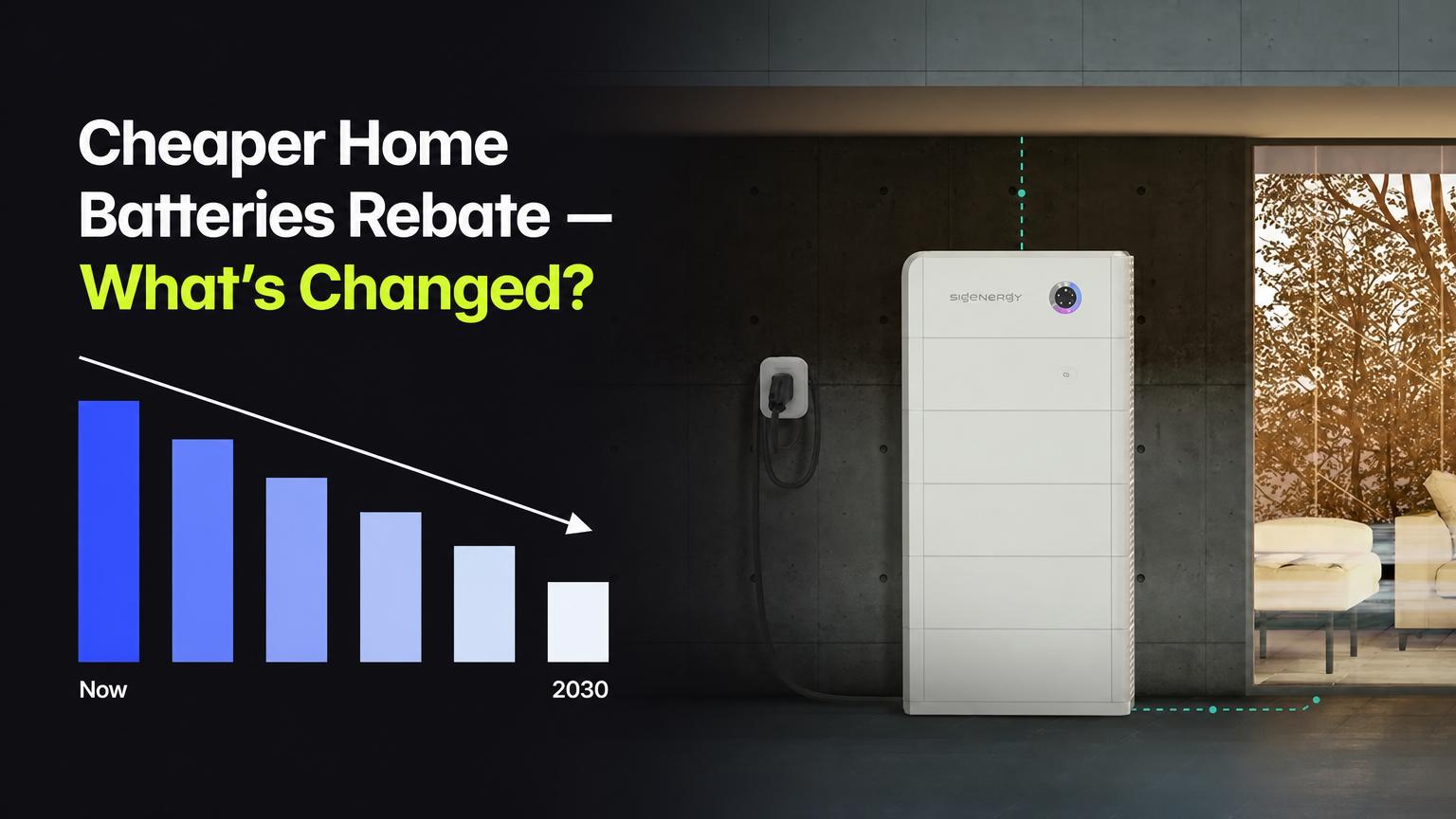
The rebate still applies for batteries from 5kWh to 50kWh. However, the bigger battery you install, the less rebate you start to receive. The percentage the rebate is applied at now also steps down every 6 months.
The rebate structure looks like this:
- 0–14 kWh: full rebate (~$252/kWh)
- 14–28 kWh: 60% of full rebate (~$151/kWh)
- 28–50 kWh: 15% of full rebate (~$38/kWh)
- Above 50 kWh: no rebate
We’ve Done the Maths for You
Use the interactive battery rebate calculator below — enter your battery size in kWh to see exactly how many STCs it earns and what that’s worth in dollar savings off the purchase price.
How Do I Apply?
To apply for the rebate, simply get a quote from a local, trusted installer. When they provide their quote, the price of the rebate should be shown as deducted off the full price.
For example: if you purchase a 9kW solar system and a 16kWh battery in Newcastle for $21,000, roughly $6,500 of rebates is deducted from the purchase price.
The amount is taken off the homeowner’s upfront cost, and once the installer and the homeowner both agree the install is complete, the installer lodges the paperwork with an authorised STC dealer.
Are There Any Other Incentives I Can Claim?
For NSW homeowners, there are two other incentives you can take advantage of:
- NSW VPP Incentive
- NSW $15,000 Interest Free Loan
NSW $15,000 Interest Free Loan
As of June 2026, Newcastle, Central Coast and Hunter Valley homeowners can fund a solar and battery system with a $15,000 interest free loan. The loan comes from a $557 million scheme launched by the NSW Government, which is aimed at helping homeowners install energy saving upgrades.
Eligibility is as follows:
- You’re an Australian citizen or permanent resident
- You own the property
- Your combined household income is under $210,000 a year
- The property is in NSW — this includes Newcastle, the Hunter Valley, Central Coast, and rural NSW
- The property is a regular residential dwelling (not social housing or short-stay accommodation like Airbnb)
- You pass a standard credit check with one of the approved lenders
NSW VPP Incentive
Newcastle, Central Coast and Hunter Valley homeowners can also receive a payment for connecting their battery to a VPP (Virtual Power Plant).
A VPP (Virtual Power Plant) is a group of home batteries which can export power from the battery to power the grid when it’s needed most. In Newcastle, this is predominantly around 4pm–9pm.
The incentive is for batteries ranging from 2kWh–50kWh, however the payment is only for the first 2–28kWh. Batteries up to 50kWh can claim the incentive, however only the first 28kWh is paid out.
The incentive is typically worth anywhere up to $1,500 for a 28kWh battery. However, the amount can change based on the market and the VPP you choose at the time of applying. NSW doesn’t specify a set rate, and an Accredited Certificate Provider (ACP) may charge an admin or brokerage fee that reduces the final amount.
Frequently Asked Questions
Should I wait or install now?
Because the rebate steps down every six months, waiting means a smaller discount — not a bigger one. The other factor is your power bill: every quarter without a battery is another quarter buying energy from the grid at peak rates.
Can I add a battery to my existing solar system?
In most cases, yes. Older inverters may need to be paired with a separate battery inverter (an “AC-coupled” setup), while newer hybrid inverters can connect a battery directly. A site assessment will confirm what’s compatible.
Will my battery still work in a blackout?
Only if it’s wired with backup loads. Not every battery includes blackout protection by default, so let your installer know if it’s important to you.
Does my battery have to be VPP-connected?
No — the battery just needs to be VPP-capable. Whether you opt into a virtual power plant later is up to you.
How long does payback take?
For most NSW households on a typical retail tariff, a properly sized battery pays itself back in 6–9 years and continues delivering savings well beyond that. The exact figure depends on your usage pattern, solar system size, and electricity plan.
Figures are estimates only. Always confirm rebate values with your installer at the time of quoting.